Monday, October 3, 2011

My Market (Akatale kange).

I'll begin this post with a sing-along.

"Making your way in the world today
takes everything you've got.
Taking a break from all your worries,
sure would help a lot.

Wouldn't you like to get away?
Sometimes you want to go

Where everybody knows your name,
and they're always glad you came.
You wanna be where you can see,
our troubles are all the same
You wanna be where everybody knows
Your name."

When the stresses of this two year existence get me down, I'll often escape to the cherished serenity of the mountains. There, I am one with the hills, nothing more than just another trudging mammal, quads burning, sweat streaming, steam rising. In the depths of the green, my skin color loses all meaning. The only thing begging for me to look their way are the rolling hills peaking through clouds in the distance. The only creatures staring are the startled monkeys peering from behind limbs. All the while, spectrum-colored birds flit about me.

Lately, I find that another place will brighten my day. Paradoxically, I escape the stress of being surrounded by jumping into a deep pool of activity. I return to the one place in Kyenjojo where quite literally everyone knows my name.

I go to my market.

For a new PCV, the market, any market, is a scary and exciting place. Transactions are happening all around you. You're dodging people, vegetables, carts and mud-puddles. And when it comes to making your own purchases, you just never know when you're getting a Mujungu-price. Your market, after all, didn't come with an instruction manual:

"Tomatoes should be 1000 shillings for a stack of 5 'big' ones and 500 shillings for a stack of four 'smaller' ones. Often, a woman will offer you 'enyongeza' meaning 'bonus' just because she is happy with your business and your attempt at speaking her local language. If not offered 'enyongeza', it is fully acceptable to ask for it using the phrase ‘Enyongeza?’, as the women often find it so hilarious that they'll give a bonus-'bonus' because you are just so damn cute!"

etc...

No. No instruction manual.

When you first arrive in town, the market is shark-infested waters. Everyone is trying to make an extra 500 or thousand off you. Why? Well... why not. They don't yet recognize that there is a dramatic difference between you and the other white guys that are driven to the market by black drivers of white Land Cruisers.

With time, however, perceptions change. It becomes known that you are the water-sanitation work/teacher/health-worker from America, that you're here as a "volunteer" and you just want to help a little bit. You're no longer seen as a mark, but, if you’ve played your cards right, a friend.

I love my market women. When I enter every Monday, I am greeted with giggles and shouts of “Osiibire ota, Amooti?!” (How have you spent the day, Amooti?!) I do my best to carry on using the extent of my language skills. My progress is slow, but every step is noted. “Nokyayega, kurungi!” (You are still learning well!) they say through bright smiles. They defend me against those calling me Mujungu. “Onu, ali Mutooro!” (This on, he is a Mutooro!)

When I’m happy, I leave the market happier.
When I’m upset, I leave the market happy.

Last week provides a great example: a man tried to overcharge me for a SIM-card for my phone. It was the first run-in with a shark I’d experienced in months, and I was absolutely livid. A ‘Mujungu-price’ is nothing more than racism packaged in a pretty box with a card that reads: “Don’t worry, it happens to all white people in Africa. It comes with the territory!”

In seconds, I went from stoked about life to pissed off and filled with loathing. Sadly, my disgust with one asshole spilled over in a sickening display of transference. Leaving the store, I wasn’t just angry with one person. I was angry with “these people.” I had pigeonholed an entire society in a span of just 5 minutes.

I resolved, even in my angry state, to go to the market to get vegetables (I had had pancakes for the last 5 meals and was in need of change).

On entering the market, I was met with the same cacophony of greetings. I tried to smile and greet back, but I just wanted to get in, out and back to the seclusion of home. I walked quickly to my friend Abwoli’s stall and told her what happened…

“A man just offered me a terrible price on something only because I am white.”
“Oh, nooooo. He should not have done that.”
“I’m just so angry! I’ve not felt this mad for a long time.”
“Are you sad?”

No. I was angry. Was I sad also? I had to think about it. Yes. Yes I was very, very sad.

“Yes, I’m sad. I’ve worked so hard to be accepted here, to be thought of as one of you. It hurts my feelings when someone treats me like a stranger.”
“Otofaayo.” (Don’t mind.) “He is a bad man. Forgive him.”

Forgive. I hear it a lot. “Forgive us.” “Forgive him.” “For me.” And something in Abwoli’s eyes sparked it in me. She then poked some fun at me, and soon we were laughing.

I spent the next 20 minutes making my purchases, catching up with the women behind each stall. With every smile, the weight on my chest reduced, I felt it easier and more natural to laugh. And on leaving, I had all but forgotten why I’d been upset to begin with.

Of course, I still remembered. I had come into contact with an asshole. But my market experience reminded me that it was only one asshole among many, many beautiful people.

I’ll say it again. I LOVE the women at my market.

I’ve often talked about the freshly-picked and incredibly affordable vegetables I eat every day, but as far as I know, I’ve never actually shown them. Surely, I’ve posted pictures of markets around Uganda (out of respect for the women at my market, I’ve never ventured there with a camera), but I never got into details about what is available, prices and how they are called here. This post is meant to remedy that. Last week, I took my camera to my market, reluctantly removed it from my bag and began to inform everyone around what I was doing.

“Nkwenda kusomesa ab’omuka mu America hali ebyokulya mu Uganda, nka ebijuma, fruits, hamu n’enyama…” (I want to teach people back home in America about food in Uganda like vegetables, fruits and meat.)

They were beyond receptive. Many, who I had thought would shrink from the camera, were asking for their pictures to be taken. They sent me to other stalls to “take their pictures!” Kids in swarms crowded around me asking to have their pictures taken. And of course, there was all the food.

So, against my fingers wishes, I’ll now cease typing. I hope you enjoy the pictures, and as always, if you have questions or comments, please don’t hesitate to contact me (deevo at vt dot edu).

[FYI: The current exchange rate is 3000 Ugandan Shillings per 1 US Dollar.]
My market!

These three pictures sum up why I am a vegetarian at site. If I really missed meat (I do not), I would probably cave, buy it, and boil it for a few days before eating it. It could be done. But again, I could care less. That said, it is always nice to have a burger or a cut of meat from a nice restaurant in Kampala or Fort Portal every now and then.

Beef - Enyama y'ente (6k /kg, ($2.00))

Fillet, anyone? Actually, my buddy has really taken advantage of the fact that butchers here haven't a CLUE as to what a "cut" of meat is (they simply take a machete to whatever slab of animal is in front of them). He pays a bit more to get meat without bone in it, and he brings his own knife to do the cutting. In doing so, he's getting fillet at less than a dollar per pound! I asked him, on average, how much meat he eats per week:

"Oh, it varies from week to week, but usual around 6 kilograms."
Guy is extreme.

Banana(s) - Ekitooke, Ebitooke (12k/bunch, ($4.00))

Bananas are steamed after being removed from these green skins. The finished product is like hot mashed potatoes, but instead, it is bananas. It gives me horrendous heart-burn, so I rarely eat ebitooke.

After being shipped in, produce is stored in these big, lockable bins. The women pay 25k shillings each to a security guard who prevents theft from the markets at night.

A typical stand: a few poles covered with scraps of fabric and plastic. I feel for the women when the harsh rains move in. Everyone gets wet on those days.

Tomato(s) – Orunyanya, Nyanya (Small pile (4): 500 ($0.17) or Big pile (5): 1k ($0.33))

Abwoli. This is the lady who sets me back on track on the down days.

Orange(s) – Omucunguwa, Emicunguwa (1k, ($0.33))

You may not see the oranges. That's because they are GREEN. A bit more tart than those in the states but no less delicious. The best are those random ones without seeds.

Egg(s) – Ihuli, Amahuli (7000k tray of 30, ($2.33))

There are two types of eggs: Village Eggs (free range) and large-scale chicken farms. The villagers are partial to the free range eggs, as am I. They are a bit smaller than the others and a bit more expensive, but the yokes are tremendous and nearly fill the shell. They remind me of the $5/carton eggs Michelle and I would get every now and then back home.

Devil onions. Smaller than a quarter, and wickedly hard to peal, every volunteer I know has made the mistake of buying these bastards on more than one occasion, declared they'd never buy them again (aloud and in texts to other volunteers) and then, of course, they buy them again after forgetting just how miserable they are. BAH!

Millet – Oburro (1.5 – 2k /can, ($0.50 - $0.67))

This is pounded to remove the shell and then ground into flour. Mixed with cassava flour and then boiling water, you get a sticky gob of food called "carro" which is served with "felinda" a soup made by removing the skin on beans and smashing them into a fine liquid. Sounds strange, but it is my favorite traditional Ugandan dish.

Irish Potato(s) (lower picture) – Ekilaya, Ebilaya (500 – 1k /stack, ($0.17 - $0.33))
Sweet Potato(s) (left and right center) – Ekitakuli, Ebitakuli (1k, ($0.33))
Cassava (upper right) – Muhogo (1k, ($0.33))

Starch, starch, starch!

Mushroom(s) – Akatuzi , Obutuzi (1k, ($0.33))

Cheese! After mutiple "Seka! Seka! Seka!"-s (SMILE! SMILE! SMILE!-s), I finally got one with some teeth. Getting Ugandan's to look anything but serious for a camera is truly a challenge. But as soon as the camera is down, they RADIATE.


Ginger – Tangawuzzi (500, ($0.17))
Avacado(s) – Vacado(s) (200 – 500, ($0.07 - $0.33))

Bean(s) – Ekihimba, Ebihimba (1 – 2k /basket, ($0.33 - $0.67))

Looking down the main isle. This is the route I take every Monday or Tuesday, jumping this way and that to share a laugh at the stalls. Notice the obstacles...

Salt – Ekisura (500, ($0.17))

This salt is taken from a lake in the middle of Queen Elizabeth National Park. There are some gnarly stories about the workers who mine this stuff (salt does terrible things to your reproductive organs when all you do is swim in it day after day). Interestingly, this gray, seemingly un-pure salt is more popular and more expensive than the iodized salt available in shops around Kyenjojo. My neighbor couldn't get the translation out. She just said that the white iodized salt is "thicker" than the gray stuff.

Carrot – Carroti (500, ($0.17))

Onion(s) – Akatunguru, Obutunguru (500 – 2.5k, ($0.17 - $0.83))

Pea(s) – Ekaho (2k, ($0.66))

Cabbage – Cabbagee (500 – 1k, ($0.17 - $0.33))
Pineapple(s) – Enaanaasi, Enaanaasi (1k – 2k, ($0.33 - $0.67))


Charcoal Stove - Sigiri (3.5 -10k, ($1.17 - $3.33))

This is how the average Ugandan cooks EVERYTHING. A small pot, clay or metal, filled up with charcoal, boils the water than steams their posho (corn meal), beans or ebitooke. I ran the numbers when I bought my last propane tank, and based on the price of charcoal vs. propane, it is far more economical for a Ugandan family to continue using these stoves or the three-stone fire method than to upgrade to gas. Why? Because everything they eat requires boiling water for hours on end. Gas stoves aren't made for that.

The results are disastrous for the environment: trees are being cut down at an astonishing rate that increases every year as the population explodes. The policy is: Cut down a tree, but plant two. But the policy is rarely if ever followed.


Blasted: They get'em started EARLY in Kyenjojo!


I totally arranged them.

Cassava is often dried after removing the hard outer root covering. After being dried, it is ground into a flour. Nasty, stuff. I can't eat it without a lot of water on hand, as it is so dry it gets stuck in my throat.

Small fish – Mukene (500, ($0.17))

Nasty stuff. Most volunteers crush it up and feed it to their cats or dogs.

Peanut(s) – Ekinyoobwa, Ebinyoobwa (3k, ($1.00))

Dry beans. They are usually around the same price as the fresh beans.

Pumpkin(s) – Ekikeke, Ebikeke (But we call it Omwongo where I stay.) (2k – and up, ($0.67 – up))

The lady at this stand tried to charge me to take a picture of her pumpkins. She is new to the market and clearly does not yet understand my place in Kyenjojo.

Green Pepper – Green Peppah (200 – 300, ($0.07 - $0.10))
Eggplant(s) – Biringanya (200 – 500, ($0.07 - $0.17))

A beautiful stand of vegetables. It took me a month to get the word "Mujungu" to stop coming out of this lady's mouth and to stop charging bad prices. We've since reached an understanding, and she is one of the ladies who stands up for me. We have a very teasing relationship.

More bananas.

Charcoal – Amakara (15k – 17k/HUGE bag, ($5.00 – $5.67))

The baskets that tomatoes are shipped to market in.

The Magical Fruit

Thanks for reading!

I hope you've learned something!

I love you all (But especially you, Michele!)

Devon.

Friday, September 23, 2011

A looooong overdue post.

Greetings from “way the hell over there”!

It certainly has been a long time since I last posted, July I think, so I figured I’d get you caught up with recent events. First off, I’ll answer my most frequently asked question as of late, namely, “Where the hell have you been?” The short answer is of course, “Uganda.” The long answer is just a bit longer…

In August, my Dad and Sister came to visit! On August 2nd, I picked them up in Entebbe, the town where the international airport lives, and on August 29th, I dropped them back off at Entebbe, hugged them goodbye and watched through lifeless glass as tears streamed from my sisters eyes. “Hey!” I said, fighting off emotions myself, “We’ll see each other soon! You’ll be Peace Corps one day, and it’ll be me visiting you!” And there I continued to stand, hassled by security (apparently, I look like a terrorist… assholes), and watched as my family cleared customs and disappeared behind barriers guarded by AK47s and sub-machine guns.

The visit was an incredible success. Dad and Cat both fell in love with Uganda. Sure, the roads could use some work (On the first LONG trip, Cat shed a few tears of discomfort). Yeah, pooping into a pit isn’t always the most pleasant (At my site, Cat had a case of violent #2’s followed so closely by a puke session that we could in all honestly give her credit for “Pooking”, i.e. going #3. And in true PCV style, she also earned her “Brown Badge of Courage” on her final night in the country. YEAH CATHERINE!!!). But they LOVED the people, the fresh fruits and vegetables and the sites. We spent many a day in Kyenjojo where they met three of my physics students (Dad took everyone to lunch at the ritzy hotel in town and we followed it up by taking about 1000 pictures of Moses playing super-model), and we also spent a day with the women’s group I’ve been working with. Riding home from the deep village with the women, Cat couldn’t stop talking about the day:

“Those women are so incredible… They are so strong, and beautiful… They are building something from nothing… They are so happy!... ”

This was the point in the trip were Cat really broke out of her shell. Dad and I had been encouraging her to take advantage of her time here, to speak to everyone she could, to learn as much as she could about the situation. Until that point, she had been somewhat introverted, but after that day, she was speaking to people freely, haggling over prices of her market purchases and enjoying her time much more fully.

Dad went wild on the visit. After 14 days in the country, the man had taken around 30 gigs of pictures! THIRTY GIGS! More than all of the pictures I’ve taken to date, in just two weeks. I told him to keep it up, to take more. This was the trip of a lifetime, and he, as well as I, wanted to document it right. The motto of the trip was; You can always delete a bad picture, but you can’t retrieve a picture you never took (actually, the motto was: “If you want that expensive bottle of liquor, buy it!” Which we followed to a T). I believe he is in the process of sifting through the masses to choose the best of the best.

I leave the details of the trip to Cat and Dad to tell you all back home. Surely they have pictures posted on Facebook and will be showing them to friends and family from their computers (I want them to take the best and make a photo album with them). I will, however, post pictures sometime in the next 2 to 7 years. No worries…

Moving on… In early September we had our All Volunteer Conference at a small hotel outside Kampala. Originally, due to budget cuts (Thank you Mr. Obama and Congress, you worthless imbeciles…) All-Vol. was canceled, but after numerous complaints from PCVs around the country, funds were scraped together and two days were allocated to the event. Miraculous! All-Vol. serves as the ONLY time in the year where volunteers can meet, mingle and exchange information about how they are handling problems and their sites and be inspired by tales of other volunteers from afar. It is probably one of the most beneficial events PC can put on next to teaching us language in our initial training, and nearly every volunteer agrees with this. Unfortunately, as I greeted one of the high ups in PC-Uganda (i.e. someone who makes around $110,000 dollars a year) telling them just how happy I was about the event materializing, my enthusiasm was met with a dull, “Well, enjoy it. It’ll be the last one for a long, long time.” Why? “Budget restrictions and Kampala Policy.”

Budget Restrictions and Kampala Policy… subjects for future posts.

All-Vol. was a great success. After two days, the volunteers that had attended were well acquainted with the new PCVs (Educators that hit the field in April, exactly one year after I myself hit the field), had met the Newest group of Peace Corps Trainees, had seen multiple presentations covering education, economic development and water and sanitation, and were well partied-out by the end. From there, we all headed back to site…

Back in Kyenjojo, I was haunted by the memories of my sister and dad’s being here. I definitely miss them, and readjusting to living alone after being with family for so long was difficult. I am now back in the groove.

School started this year with an attempted strike by the teachers of Uganda which was as affective as the strike that we ended the second term with (read: not affective at all). Why the strike? The teachers want to be paid more. How much more? They want 100% increases in salary (i.e. a secondary school teacher who only shows up to class 50% of the time wants to be paid as much or more than a Ugandan doctor or Lawyer, who also probably only show up 50% of the time to their jobs…).

As expected by all, even the teachers, the self-destructed almost immediately. UNATU, the Ugandan Teachers Union failed to rally the schools and keep them in the loop, so some schools remained closed while others continued teaching. The government won’t turn its head if only a few schools out of hundreds refuse to work, so by day two, most schools had reopened and teachers were back to not showing up to class and the students were back to not learning while being forced to sit in crowded classrooms all day…

I taught through the one day of strike, so I guess you could call me a SCAB. My reasoning, and I explained this to the teachers, was that I was not paid by the Ugandan government, and therefore I had no reason to be angry. That, and I have so much more to cover in my classes that I cannot afford to miss days of school (Neither can they. Their classes will simply suffer now and down the road). There are a few teachers at my school that I have the utmost respect for, and in their cases only, I understand and support their desire to strike, namely:

(a.) A Universal Secondary School (USE) teacher’s salary is too low for a person to send their children to private schools in order to avoid the horrendous education that USE schools provide. (A good Kampala school can cost 800,000 per three month term, meaning a secondary school teacher desiring a good education for their kid would work full time simply to pay the school fees of ONE CHILD… what happens when that parent has 3 or 4 children?)

(b.) If the government refuses to pay teachers and schools, then the teachers cannot work, and the schools shut down. This is obvious as refusing to refill your cars gas-tank while trying to take a cross-country trip. Something’s got to give…

Speaking to the teachers that I do care for after the strike, I applauded their efforts and encouraged them to try the strike again another time but with better organization (while gently mentioning that a 100% increase in salary was a bit ambitious, though looking back, they could have unknowingly been using the “door in the face” method of negotiation). I also mentioned, as in spilling the words into the air where they could float freely and not put anyone under my finger, that for it to even be cost effective for the government to respond to the strike that teachers would have to better fulfill their end of the deal (i.e. improving their attendance, anything over 50% would be an improvement, and doing more than simply reading notes to the kids each class and testing at the end of the term).

It is safe to say that after swimming in it for 18 months, I hate the Ugandan education system with every atom of my being. Underfunded (with the remaining funds plundered by fat, pin-stripe suit wearing cavities…) and therefore understaffed and with an almost comical lack of teaching materials, the test-based system is a multi-tasking demon: while robbing students of the joy of learning it devours from teachers the joy of teaching.

I continue to feed a ravenous hunger for books. Among my recent top-reads was “Dark Star Safari” the tale of Paul Theroux as he travels overland from Cairo, Egypt to Cape Town, South Africa. The story of Paul’s journey was especially intriguing to me for more than the fact that I will be doing my own overland trip from Cape Town to Cairo beginning in December. You see, this was not Paul’s first trip to Africa; in the early 60’s, he had been a Peace Corps Volunteer in what is now Malawi before becoming a professor at Makarere University here in Uganda. He returned to Africa after more than 30 years abroad, and was confronted by the discontinuity between Pre-developed and “developed” Africa, one that I liken to a wise grandfather and a spoiled-rotten grandchild, respectively.

He summarizes his findings at the beginning of the book as follows:

“Africa is materially more decrepit than it was when I first knew it – hungrier, poorer, less educated, more pessimistic, more corrupt, and you can’t tell the politicians from the witch-doctors. Africans, less esteemed than ever, seemed to me the most lied-to people on earth – manipulated by their governments, burned by foreign experts, befooled by charities, and cheated at every turn. To be an African leader was to be a thief, but evangelists stole people’s innocence and self-serving aid agencies gave them false hope, which seemed worse. In reply, Africans dragged their feet or tried to emigrate, they begged, they pleaded, they demanded money and gifts with a rude, weird sense of entitlement.”

Entitlement is the name of the game. From little kids and adults coming up to me and saying, “You give me my money!” to the heads of state who are happy with the current scheme of things (one in which for the last many years, upwards of half of Uganda’s yearly budget has been funded solely by foreign aid... and still is). The more I read about foreign AID and its negative effects, the more I am appalled by the (a.) fact that money continues to flow in, straight into the pockets of corrupt leaders doing absolutely nothing for their people and (b.) if you view the lack of good governance here as a “Strike”, then I am nothing more than a SCAB once again… I’m filling a roll that another able-minded Ugandan could fill but won’t because they would never sink so low as to become a teacher due to lack of necessary funding from the pin-stripe suits on high.

For months now, I’ve justified my presence in Uganda with the statement: “Well, I’m not giving money, I’m giving an education, and there can’t be anything wrong with that!” But again, I’m just a very-very-very small excuse for the government to not take responsibility and continue making a mess of things. A battle of morals rages within me.

Later in Dark Star, Theroux, with startling accuracy, defines his stance on foreign AID.

“It is for someone else, not me, to evaluate the success or failure of charitable efforts in Africa. Offhand, I would have said the whole push was misguided, because it had gone on too long with negligible results. If anyone had asked me to explain, my reasoning would have been: Where are the Africans in all this? In my view aid is a failure if in forty years of charity the only people still dishing up the food and doling out the money are foreigners. No Africans are involved – there is not even a concept of African volunteerism or labor-intensive projects. If all you have done is spend money and have not inspired anyone, you can teach the sharpest lesson by turning your back and going home.”

This update has gotten just a bit out of hand in length, and for that I apologize. This is what happens when I slack on posting!

I write to you now from Kampala. I took a bus in yesterday morning after saying “enough is enough, I need to see medical.” For at least a week now, I’ve had a pain in my left year when I touched it, layed on it, etc… At times it felt like something was crawling around in there. Using a cue-tip, I got a bit of dirt out, but the pain progressed and being deep inside the ear, I was worried that I might be doing damage by letting it go. Well, the diagnosis was simple: “AH! You have BIG ball of wax in there!” which I took as good news, for it was better than hearing, “It seems a cockroach has turned your tympanic membrane into a pillow!” The fix was also simple: squirt some peroxide in there, let it work on breaking up the funk and then flush the ear out with rocketing streams of warm water with the syringe. After 5 or 6 pulses, a few of which brought mist to my eyes, I heard an “AH! GOT IT!” And after one more pulse a piece of wax the size of the tip of my pinky finger fell into the collection container. Shockingly, considering the size of the plug, I don’t feel that I can hear any better, but the pain is gone, and I have a new nasty photo to show you of what our bodies can produce.

My trip to Kampala lined up with another far more exciting trip planned for this weekend: The Rhino Fund’s RACE DOWN THE NILE! Just like last year, me and a team of 5 other racers will battle it out with a number of other boats for the grand prize (last year it was a round-trip flight to Nairobi!). All proceeds go to the Rhino Fund, an organization formed in hopes of reintroducing white rhinos into Uganda’s game parks (It warrants mention that this organization was not spearheaded by the Uganda Wildlife Authority further showing the “FreeMoneyYESplease!"-mindset.) This year’s event is special in that it will be the last time the race will occur at Bujagali falls. By next year, a new dam will have opened, and all of the falls will be under water. As an additional celebration, there will be two-man kayak races too. I’ll let you all know how things go. Our team consists of 5 burly gentlemen and 1 strong lady, so our hopes are high!

Alright. This update has gone on FAR too long. I apologize for my lack of brevity, but I had a lot to cover. And how about this: if you’ve made it this far, I’ll sit down to drink a few beers with you after I return Stateside. Your treat!

Know that I am still doing well in Uganda. Am I struggling? Yes, and no. Physically, no. Mentally, yes. I’m still having a great deal of fun, but service has been eye-opening. My blind idealist mind-set, born and raised on organic bunny-hugger propaganda is currently at war with my realist mind-set born of experiences on the ground. Ignorance is bliss, and these days I find myself thoroughly sickened and deeply saddened by what I see in the (3rd) world around me.

Thanks for reading!

I love you all (but especially you, Michelle!).

Devon.

Wednesday, July 20, 2011

The "M"-word.

When Ugandan’s learn that I have a girlfriend, I am often offered a wife on the spot.

“You take a Mutooro woman! They are very beautiful. Take this one!”
When I decline, I must always be sure to inform the speaker that, “yes, Mutooro women are beautiful,” and “no, I have nothing against Ugandans/Africans.” Once that’s diffused, I am inevitably asked a series of questions about our relationship. Two in particular always bubble to the surface:

(1.) How can you know that she is true to you?

(2.) Don’t you get feelings?

I’ve discussed my answer to the first question in a previous post, but obviously, it boils down to trust. Trust is often best conveyed by using the word “faith” in its place.

“Well, how do you know there is a god that has a plan for your every daily choice and future?”

“Because I believe in him.”

“So you have faith in him?”

”Yes, faith. I have faith in my lord and savior.”

“Well, I have faith in my girlfriend. I have faith that she does not want to find another man.”

“That’s good… but don’t you ever get feelings?”

And there’s question number two.

Feelings of course mean “sexual feelings.”

“Yes. Of course I do.”

“Well,” they say, giving me a deeply questioning look that says What do you do about them?

That question, if posed to any American child from somewhere around middle school age and up, has an obvious answer. To most Ugandan’s, however, the solution is not so straightforward. While perusing the manual outlining the “Presidents Initiative on AIDS Strategy to the Youth” (PIACY, pronounced “Pee-Aww-See”), I stumbled upon the reason why.

The book uses a question and answer format:

“Is it wrong to practice masturbation?”

Answer: In Africa and in Uganda, it is socially, culturally and morally not accepted. Likewise, religious principles do not allow this sexual practice.”

Why doesn’t the word “masturbation” jump into a Ugandan’s head as a potential solution to “feelings”? Because to participate in the act is an affront their country, their continent and their religion.

Straight from the PIACY manual, incorrect grammar/spelling and all.

PIACY doesn’t stop there:

“Does masturbation protect one from HIV/AIDS?”

Answer: It does not provide you with effective protection from HIV/AIDS because you are likely to end up in penetrative sex. Penetration is the predominant approach to sex in Africa. Many young people who practice masturbation as a “safer sex practice” therefore end up being emotionally triggered into penetrative sex, which increases their risk to HIV.

How are marijuana and masturbation alike? It turns out they are both gateway drugs!

Fear not. PIACY gives young Ugandan’s the means to abstain this devious act:

“How can one resist pressures to masturbate?”

Answer:

(1.) Do not let your mind dwell on thoughts, pictures and literature that influence sexual feelings.

(2.) Avoid watching or reading material which arouses your sexual feelings.

(3.) Avoid hanging out with people who say and do things which may arouse your feelings in that direction

(4.) Be assertive and speak out your stand regarding your values.

(5.) Develop Godly principles and honor them.

(6.) Keep close company with people and friends who share your values.

(7.) Find active ways of occupying your redundancy period such as sports, music, drama, reading positive literature.

[Note: The exercise of picking each of these points apart is left to the reader to be done in one of their “redundancy period[s].”]


"Masturbation is wrong.
Do everything to stop it.
Yes it is possible to stop it."
["With friends like these, who needs enemies?"]

Needless to say, the super-majority of Ugandans choose the lesser suggested and HIGHLY effective method of both resisting the urge to masturbate WHILE relieving sexual feelings. They…

(8.) Have A LOT SEX, UNPROTECTED and with a VARIETY of sexual partners.

…the results of which are catastrophic:

The population of Uganda is exploding. As of 2010, there were an estimated 33.8 million people (49% of which are under the age of 15) living in a space somewhere between that of Utah and Wyoming. Following current trends (3.4% /year) the projected populations for the years 2025 and 2050 are 53.5 and 91.3 million, respectively. (Source: http://www.prb.org)

The percentage of people infected with HIV in Uganda is 6.5-7% (though many believe these to be very optimistic), and the number is climbing. In fact, Uganda is the only sub-Saharan recipient of The United States Presidents Emergency Plan for AIDS Relief (PEPFAR) money where the prevalence of HIV/AIDS has recently INCREASED. (Source: http://www.unaids.org)

So how do I handle the topic of “it” when it comes up in the conversation?

First, I tell my listener what PIACY suggests.

Then, I line those suggestions up against a wall and execute them with a quiet-rage reserved for a government who is systematically planting land-mines that will inevitably kill cities of innocents.

Finally, I dispel the myths (“No, you will not lose interest in wo/men.” “Yes, you will still be capable of producing children one day.” "No harry palms..." etc…), and I praise the benefits (“No HIV/AIDS!”, “No BABIES!”, “It’s FREE!” etc...).

Ultimately, we part. I’ve spoken. They’ve listened. But like a farmer who lays the seed, walks away and never returns: I’ll never know what’s grown.

And the weeds continue to strangle everything in their path.

Thanks for reading!

I love you all (but especially you, Michelle!).

Devon

P.S. These are old but no less relevant: Human Rights Watch, Success Story Unraveling

Thursday, July 14, 2011

My First Portrait.

After first noticing his drawings of other students and people done using MS paint, I was quick to praise the artist, an S3 student here at Kyenjojo SS. Unlike most of the students here - who do the same thing day in and day out, typing the same words over and over again exactly as they were first given to them by a teacher - he is using the computer as a creative outlet.

He found MS Word, he found the "Spray Paint" can and he hasn't looked back.

One day he came to me and says, "Masta', you come look."

And there it was: my first portrait.

It immediately drew a crowd.

Kids giggled and laughed all around, because there I was: a beard, my long straggly hair up in a pony-tail, my cargo pants and SSC shirt... even my long-worn bracelet (though he got the hand wrong).

[And what do I do when using the computer? I check Gmail, of course!]

I saved it to a USB like I have a few of his other drawings.

This morning he showed me yet another picture of me - this one done in a sketch book for is Fine Art class - only this time I was walking across the school yard with my backpack and water-bottle in hand. The picture was accurate right down to my Chacos.

While I am flattered by the sentiment, I must admit, it is just a bit unnerving (ahem, creepy) to realize that when I think I am sitting alone at a computer or walking across campus, I never escape the watchful, curious eyes of my community. And now, one of them might just be recording it with sweeping strokes of a pencil or mouse.

After 17 months in Uganda, there is still a small piece of me, deep inside, that screams when it knows that it is being watched. But every day, the scream diminishes.

Thanks for reading!

I love you all (but especially you, Michelle!)

Devon.

Saturday, July 9, 2011

Tetanus for Teaching.

About two months ago, my friend Charlene (a PCV, and also a fellow Virginian [she lives about 8 miles from my dad and we share 8 or so mutual friends... small world]) invited me and a few others to her Primary Teacher's College for a Science Demonstration Day. She asked that we bring around 5 demonstrations to show the kids and told us we would have three 30 minutes sessions attended by 50 kids each in which to teach.

For some reason... I wanted my session to steal the show, to bring the house down, so start a riot... And what accomplishes this desire with students better than the potential for DANGER and EXCITEMENT??!?!! (The correct answer is: NOTHING.)

I built a bed of nails!! (DUN, DUN, DUNNNNNNNNN!!!!!!)

This project in the states would have taken about an hour, maybe less with right power tools. Here in Uganda? It took about 6 hours of SOLID work. I had to locate the wood, haggle over the price, find a drill-bit, fix my stupid hand-held drill (twice), drill a shit-ton of holes, pound a bunch of nails through those holes, sacrifice my back to the evil contraption to see if it "worked", drill MORE holes, pound more nails and sacrifice my back again to ensure that I was successful.

It was AWESOME! And using it was even BETTER!


My original grid was 1 inch x 1 inch.

Here is my POS hand drill.

A close-up of the tip. Note 2 things here: (1.) The "drill bit" is actually a NAIL! The carpenter in town didn't have bits, but he said I could sharpen the tip of a smaller nail with a file and it would work fine. It worked GREAT, and I saved money on the bit! (2.) See the welding? Yeah, these drills are the six-sigma rejects that no one else in the world would accept... save Uganda. I had it tack-welded the first time (that failed). I had the guy use half a welding stick the second time.

Drilling A LOT of holes. There were around 400 nails in the finished board. On each of the 10 lines along the boards width, there were 22 nails. 22 nails on on would grain creates MONSTER cracks. Pre-drilled holes are a must (in the states you can just use peg board).

Here is the product after throwing nails into all of the original holes. That empty space is the location of what developed into a full board-length crack. I didn't put nails there in hopes that the crack would not propagate (it did anyway, so later I put in the nails).

Here is my back after my first try on the board. The inverted pictures shows the holes better. It hurt like HELL laying on this thing, so I had to add almost 200 more nails.

I placed the extra holes in the middle of each square. The big crack is clearly visible, but the bed didn't fall apart because of the added supports across its width.

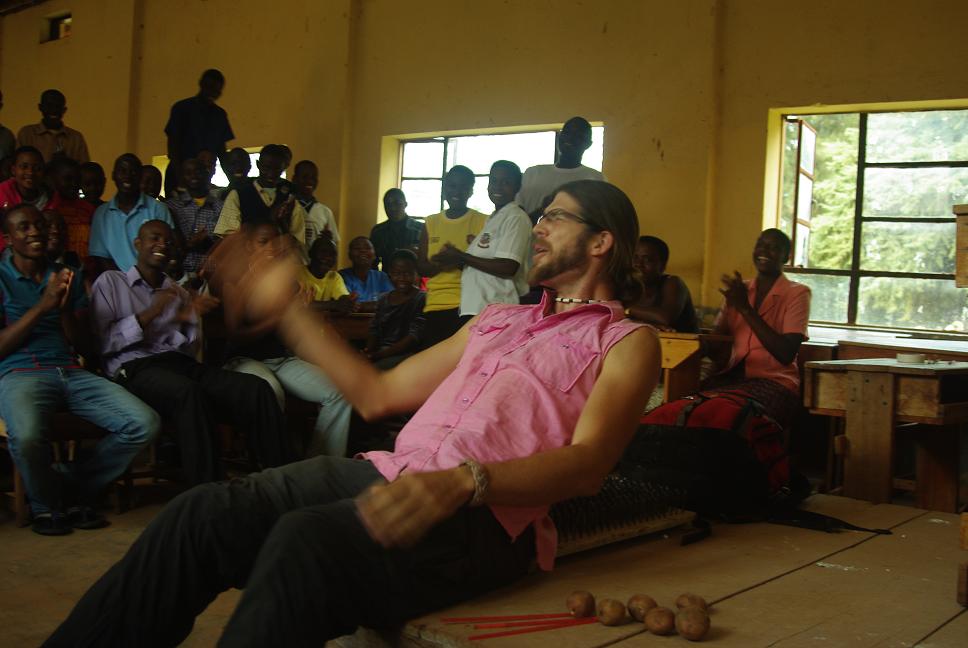
FIERCE! It was hilarious traveling with this thing from Kyenjojo to Ibanda. As I walked by I kept hearing people say, "VERY! VERY! DANGEROUS!" while pointing to me. The cool thing was that I didn't even have to bargain down the Mujungu-price set by the Fort-Kamwengi and Kamwengi-Ibanda taxis like I normally have (I don't think they didn't want to risk my fury :)).

I saved the bed for the last demo. I gathered all the students together around the stage. Here I am inciting their cheers ("Listen, I'm scared of this thing! If I don't hear your cheers, I don't know if I'm going to have the strength to do it! CHEER, CHEER, CHEER!!!"
(Sorry about the blur.)

The first part is the worst. It does hurt a bit.

SUCCESS! It didn't kill me after all!! I love the faces in the background. People were cheering and clapping and jumping up and down. I never really thought I'd enjoy a stage... but on occasion, I definitely do! (look at that dirty butt!)

Of course others in the crowd had to try it out.

Try as I might, I could not get a girl to try the bed. But plenty of guys either volunteered during the demo or simply ran up to the front of the class when my back was turned to try it on their own. It was definitely a hit!

The bed of nails was a TOTAL success. It accompanied 4 other demonstrations that showing various applications of pressure.

While the kids may not remember the MATH behind the "magic," I doubt they'll ever forget the day when they saw an irish-potato get STABBED right through the middle by a 3.5 inch nail but then watched in amazement as a (part)-Irish MUJUNGU tried to go to sleep on a hole bed of the same damn nails a few minutes later!

Thanks for reading!

I love you all (but especially you, Michelle!)

Devon.

P.S. How do you like my pink, cut-off denim shirt? The back is covered in white Hawaiian flower outlines. I am the epitome of elegance and taste!

Thursday, June 30, 2011

Physics Blows?

When I think back on high school physics at Northside, I remember three things off the top of my head.

(1.) A competition to see who would create the best egg catapult that fit inside a 1 ft cubed box and weighed less than 1 kg (2.2 lbs): I came in second place to Jamie Close. (His father, a mechanical engineer, designed and built his... it was INCREDIBLE [It took Jamie, a HUGE football player, all his strength to cock the damn thing!]) Mr. Simmer's didn't think a single one of us would be able to break 50 yards with his design requirements, but Jamie's catapult, if I remember correctly shot his egg 54 yards.

(2.) Mr. Simmers had jokes or small puzzles at the beginning of each class. Example: "What do you call a millionth of a mouth-wash?" Ans: A micro-scope. (Get it? Micro = 1e-6 = 1 millionth, and scope is a mouth-wash!). Another example: "What is a Joule per second?" Ans. A WATT (get it? What = Watt!) Jokes are always better when explained.

(3.) One day, Mr. Simmers brought a glass tube with a plunger on it to class. He put a small piece of paper inside the tube, inserted the plunger and with a massive pressing motion forced the plunger downward. What happened? The paper caught on fire!!!

Two thirds of the things I remember of physics in HS happened in a total of about 10 seconds. The time it took to tell 2 jokes plus the time it took to slam a plunger down. And sure, the jokes were corny as hell, but I've never forgotten that "micro" means "millionth" or that a watt, a unit of power (i.e. rate of change of energy), has a unit of a Joule per second. And I'm never without a picture of what an Adiabatic Compression process can result in!

That information STUCK!

My point: sometimes, it is the small stuff, the things that teachers could look at and think my god that is trivial, that really lodge bits and pieces of information into kids heads.

Many times in the last year-plus that I have been here in Uganda, I've gotten completely wrapped up about the amount of material that I have to cover. I get so stressed, so frazzled, that I focus more on the derivations than presenting the principles in a way that makes my kids ABLE to remember them, in a way that makes them worth remembering ... that makes them fun.

Classes like that suck. I hate them. Surely my kids do to.

So I've tried to incorporate more 5 minute demos here and there to illustrate more complex topics we've been studying. I present them as "magic" tricks, and afterwards, I discuss the science behind them.

In the next few blog posts, I'll try to post a few of the better demo's I've done along with some pictures. We'll start with Bernoulli's Principle.

Have you ever seen the ball above the blow-dryer trick? You turn a blow-dryer on and place a light, round ball in the air stream. One who has never seen the trick before when asked might suggest that the ball will simply blow away when dropped into the stream. What happens? It levitates! Why?

Bernoulli's principle!

Air passes around the ball with approximately equal streams of air on all sides. Because the total pressure along a stream line is constant and all the stream lines are roughly the same, the pressure and thus the force acting on the sides of the ball cancel out (thereby keeping it above the stream of air). The ball levitates above the stream because of a static pressure at the bottom surface of the ball. The static pressure creates an upward force that eventually equates with the balls weight, so the ball floats within the air stream.

I didn't have a blow-dryer here in Uganda (though absolutely need one after 18 months of not cutting my hair). So my air supply was limited to what I could generate with my own body. It needed to be constant over a longer period of time, so the tube I blew through could not be to large (large area = more space to air escape = one breath escapes a lot faster... it takes less time to blow a chest full of air through an open mouth than lips puckered to whistle). A STRAW!

Now, what type of ball could I use? It had to be small and light enough to be balanced by my measly puffs of air. A PING-PONG ball! (The problem of course is that these are hard to come by here. I had to wait until I passed through Kampala at mid-service to get one).

Well, I finally got the supplies, and last week I was able to do my experiment. The following pictures show how it went.


Proper execution requires that you hold the straw perfectly straight up and down so the air flow is vertical AND drop the ball on top once you've begun blowing. Clearly, this was not a one man job for Mugisa.


... so Moses stepped in to help. The next important step is to coordinate when you drop the ball onto the air stream. If you drop the ball to soon, you get hit in the face with a ping-pong ball. If you drop it too late, there isn't enough air flow to keep the ball up. We ended up doing an "Ok, on the count of three, you start blowing and I will set the ball down then." Of course then it was a "Is it one, two, three...?" or "is it one, two, three, go?"

Here I am marveling at our fist successful levitation. Moses is holding the straw, and Mugisa is acting like a bag of hot air.

Moses gets a turn. Suzy, the only girl in the class does the drop while Ivan (at first completely against the experiment because he was just 'too cool') holds the straw ("Vertical Ivan, VERTICAL!").

Suzy, wearing a skirt, is unable to lay on the three stools we had set up, but the table worked just fine.

All in all, the experiment worked our perfectly. Each kid got a chance to try. Afterwards I was able to go through the physics behind the magic, and before leaving each of them, almost at once, they asked me if they could keep the straws and borrow a few ping-pong balls so they could do the trick for their families.

"Of COURSE!" I replied.

I am still stoked by their excitement.

Thanks for reading!

I love you all (but especially you, Michelle!),

Devon.

Tuesday, June 7, 2011

Poor Billy

“You cut a [goat]’s throat to let the blood out,” said Jack, “otherwise you can’t eat the meat.”
“Why didn’t you – ?”
They knew very well why he hadn’t: because of the enormity of the knife descending and cutting into living flesh; because of the unbearable blood.
Lord of the Flies, William Golding

“Dude, he’s still alive! Just fuckin’ kill him, would you?!” I shout.

I’m up to my elbows in blood. Spatters extend as high as my face, my glasses freshly freckled. People stand around us, staring in various degrees of wonder. Cameras snap and roll, recording these moments for eternity.

His back legs, initially kicking in fear are now clamped in Brian’s rock-climber grasp. His front legs are held by a stranger. And clasped between my hands is the head of an old billy-goat, his neck exposed and gushing as his executioner works quickly to finish the deed.

All of this started several weeks ago with a simple declaration: “I’m going to kill a goat and roast it for my birthday.” Soon thereafter, the sacrificial grounds were selected, friends were assembled, the goat was purchased and before Lex knew it, the desire to expose his inner hunter/gatherer was realized.

I’ll admit, I was stoked about the weekend and the prospect of being so “Peace Corps.” After all, how often does one get to partake in the selection, slaughter, butchering and roasting of their meat back in The States? Sure, we’ve seen farm animals, but how many of us have actually acted according to our lofty position in the food-web? I dare say, not many.

I was excited about the learning opportunity… right up until I saw the damn goat and realized, whoa, that is a living, breathing creature. He experiences pain. He enjoys food. I bet he enjoys sex. We have a lot in common.

There he was, chomping away on elephant grass, completely unaware of the fact that in less than ten minutes, he would be dead. You poor bastard, I thought, you don’t even know what’s coming. I pitied him.

Soon, I was holding his head, splashed with his fear and hoping, as surely he was, that it would all just - end.

Those present at the killing will tell you that I was clearly shaken by the experience. How so? Did I become a vegetarian? No. Did I start believing that “animals are people too!”? Absolutely not. More than anything, I was interested in finding the source of my intense discomfort born of the slaughter.

I found it. You don’t even know what’s coming. What a strange thought. Because neither do I; neither do we. While we know which way our on/off-switch invariably flips, during the interim it has a mind of its own. But the same cannot be said for animals. More often than not, their life-switch is controlled by a bigger, more blood-thirsty being.

I had aided that being. I, too, had blood on my hands.

Perhaps I sound regretful over my participating in the goat roast. I am not. It was a learning experience that provided an extreme adrenaline rush. But unlike the emotions that arise from, say, adventure sports, those that I experienced were of a more brooding nature, and they forcefully opened the “ethics of an omnivorous diet”- can of worms (an extremely healthy food for thought) that I had previously shelved.

Devon, would you do it again?” Absolutely. “Will you do it again?” The jury is still out.

Note: For a fantastic investigation of the world-wide economics (Ahem, “sustainability”) of meat-eating, I highly recommend the book Hope’s Edge written by Francis Moore LappĂ© and her daughter Anna.